Mastering the Crapo Card Game Strategies
Tired of Solitaire being a lonely game? Crapo is the answer. It takes the satisfying puzzle of stacking cards and turns it into a fast, competitive, head-to-head battle for two. But before you can dive into the action, a proper setup is essential. Getting the layout right ensures the game flows correctly and fairly, and thankfully, it’s a simple process that takes less than a minute once you know the steps. To know more, check out PANGLIMA88
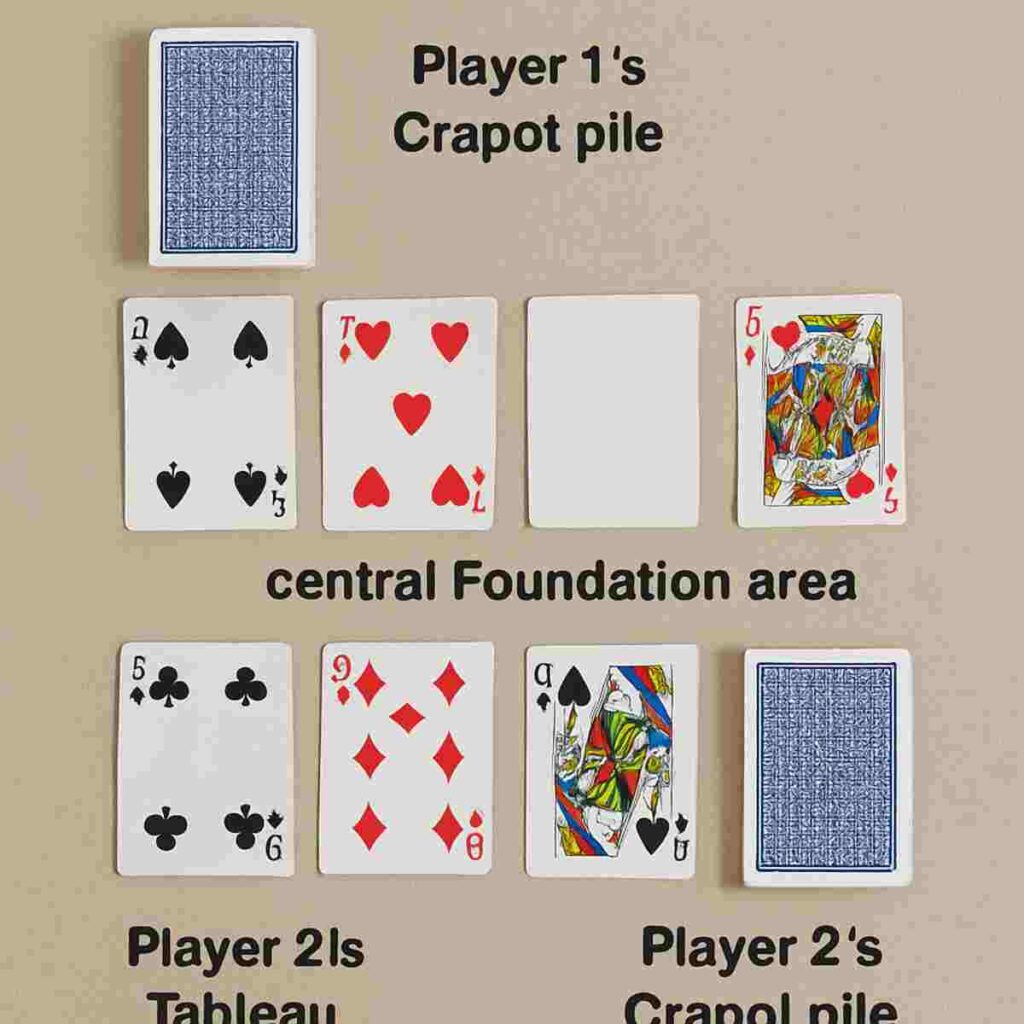
The first thing you’ll need is two standard 52-card decks shuffled together into a single 104-card deck. From this, each player will create their most important pile. This is called the Crapot Pile, and it’s your personal 13-card challenge deck that you must get rid of to win. Unlike other cards you’ll play, this pile is dealt to you by your opponent, adding a fun interactive twist right from the start.
Once your Crapot Pile is set, you’ll build your main playing area. This is known as the tableau, which functions much like the iconic columns in Solitaire. Each player will have their own four-card tableau in front of them. The large space between the two players is reserved for the foundation piles. These eight piles are shared, and they are where both players will race to build suits up from Ace to King.
To ensure you follow the official Crapo rules, here is the exact Crapo card game setup and layout process. Knowing how many cards you deal in Crapo is the key to a perfect start.
- Shuffle: Combine two 52-card decks into one 104-card deck.
- Deal Crapot Piles: Player 1 deals 13 cards face-down to Player 2’s Crapot Pile. Then, Player 2 deals 13 cards face-down to Player 1’s Crapot Pile.
- Deal Tableaus: Each player deals four cards from the main deck, face-up, in a row in front of them to create their tableau.
- Create the Stock: The remaining cards are placed face-down in a single pile, accessible to both players. This is the Stock Pile.
When you’re finished, your playing area should look like the diagram below, with each player’s Crapot Pile and tableau separated by the central space for the foundations and the Stock Pile. With the board set, you are now ready to make your first move.
Playing to the Foundation Piles
While the tableau is your main workspace, the eight foundation piles in the center of the table represent the finish line. The central objective of the Crapo game is to move all your cards onto these piles. Because any card played to a foundation is gone for good, making a move here should always be your top priority. If you have a choice between playing a card on your tableau or on a foundation, the foundation is always the better move.
Starting a new foundation pile is a simple but powerful action. Whenever an Ace becomes available—whether from your Crapot pile, your hand, or the top of your discard pile—you can immediately play it into one of the empty central slots. For example, if you uncover the Ace of Spades, you can place it in the middle to begin the spade foundation.
Once a foundation is started, players build upon it in ascending order, following the same suit. For instance, the 2 of Spades can be played on the Ace of Spades, followed by the 3 of Spades, and so on, all the way up to the King. Both you and your opponent can play on any foundation pile, so you might find yourself helping them just as often as they help you. Always scan the foundations for a possible play before looking anywhere else.
Building on the Tableau
When a move to the foundation isn’t possible, the tableau becomes your primary workspace. The rule is simple and should feel familiar to anyone who has played Solitaire: you build columns downward in descending order, alternating between red and black cards. For example, if one of your columns shows a Queen of Hearts (red), you are free to play any black Jack on top of it, like the Jack of Clubs or Jack of Spades.
As you build these sequences, you’ll unlock one of the game’s most powerful mechanics: moving entire stacks. Any correctly ordered stack of cards on the tableau can be picked up and moved as a single unit to another column. Let’s say you have a Red 9 sitting on a Black 10. If you later uncover a Red Jack in another column, you can lift both the Black 10 and the Red 9 together and place them on top of the Jack. Shifting stacks like this is the key to rearranging your board and unblocking the cards you need most.
Creating an empty column in your tableau is a breakthrough. A space offers incredible flexibility because it can be filled with any single available card or any valid stack of cards. This is a golden opportunity to move a problematic card from the top of your Crapot pile or to strategically rearrange your board to uncover the face-down cards underneath.
Turn Structure and Drawing Cards
So, you’ve scanned the foundations and the tableau, and there are no more moves to make. This is a common situation, and it’s when you turn to the other stacks of cards at your disposal. However, you must follow a strict order of operations. This rule prevents players from simply ignoring the board and cycling through their cards; it forces you to deal with the puzzle in front of you.
Your Turn Priority:
- First, look for any plays from the cards already revealed on your tableau or on top of your Crapot pile.
- If (and only if) you have absolutely no moves available from those areas, you may then draw from the Stock pile.
The Crapot pile is the face-down stack of 13 cards you were dealt at the start, with one card turned face-up on top. Your primary objective is to empty this pile. You can only ever play the top, face-up card, either onto a foundation or the tableau. Successfully playing this card allows you to flip the next one over, revealing a new opportunity.
If you’re blocked and have no moves on the board, you must turn to your Stock pile. To continue your turn, take the top three cards from your Stock and flip them over as a single packet, creating a new face-up pile next to it called the Waste pile. The top card of these three is now available to be played. If you play that card, the card underneath it becomes available. If the newly revealed card has nowhere to go, your turn is now officially over.
As the game progresses, you’ll likely flip through your entire Stock pile. When it’s empty, you simply pick up your entire Waste pile, turn it face-down without shuffling, and it becomes your new Stock. This cycle of playing, flipping, and recycling continues until one player wins.
The Game-Changing Move: The “Crapot Dump”
You’ve successfully emptied your 13-card Crapot pile, which is a major victory in itself. Now, you’ve unlocked the most powerful and defining move in the game—the one it’s named after. The “Crapot Dump” is central to most winning strategies and is the primary way you shift from managing your own cards to actively disrupting your opponent.
Once your Crapot pile is gone, you can perform this move at any point on your turn. To execute it, you simply pick up your entire Waste pile and place it directly on top of your opponent’s Waste pile. Suddenly, all the cards you couldn’t play are now your opponent’s problem. This is a devastatingly effective move because it buries their cards under a fresh stack they must now work through before they can cycle their own Stock pile again.
Executing a successful Crapot Dump can completely turn the tide of the game, transforming a close match into a commanding lead. It’s the reason why emptying your Crapot pile is your top priority. Getting rid of those 13 cards isn’t just about reducing your own card count; it’s about unlocking the ability to bury your opponent.
How to Win the Game
So, after all the card-flipping and stacking, what does victory actually look like? The ultimate objective in Crapo is to be the first player to empty both your personal Crapot pile and your stock/waste pile. Once those two sources of cards are gone, you’ve won the game, regardless of any cards left on your tableau.
For players accustomed to keeping a running tally, the Crapo scoring system is refreshingly straightforward: there isn’t one. Victory is a clear, all-or-nothing event. You either win by emptying your piles first or you lose. This head-to-head race is what makes each move feel so critical.
But what happens if the game just… stops? In the rare event that both players get stuck, a draw can occur. If you and your opponent both cycle through your entire stock pile one full time without either of you being able to make a single legal play, the game is considered a stalemate.
Common Mistakes to Avoid
Many first-time players fall into a few common traps that can quickly lead to a frustrating loss. By understanding these pitfalls, you can start playing with a solid strategy from your very first game.
The most frequent mistake is treating Crapo like single-player Solitaire. It’s tempting to immediately flip cards from your stock pile when you feel stuck, but this should always be your last resort. Before you touch that pile, exhaust every other option. Check if you can play a card from your Crapot pile or move cards between the tableau columns. The cards in your stock are a major obstacle to winning, so adding more to the board before you absolutely have to is a losing strategy.
Another common oversight is focusing only on your own side of the board. Don’t forget: you can play cards on your opponent’s tableau! If you have a 7 of Hearts available and your opponent has an open 8 of Clubs in their tableau, playing your card there is a fantastic move. Not only does it help you empty your piles, but it can also block your opponent. Always scan the entire play area for opportunities.
Finally, a simple rule of thumb can dramatically improve your chances: never hold onto an Ace. Aces are the seeds of the foundation piles, which are the only way cards permanently leave the game. While it might feel like you’re helping your opponent by starting a new foundation, you’re actually opening up more opportunities for everyone, including yourself. Playing an Ace as soon as it appears is the single best way to keep the game from grinding to a halt.
Crapo vs. Russian Bank: What’s the Difference?
If you’ve been looking for card games similar to Crapo, you’ve almost certainly stumbled upon its close cousin, Russian Bank (also known as Crapette). While they share a competitive Solitaire DNA, a few key differences in the rules create two very distinct experiences. The most obvious change is the layout. Russian Bank is typically played with eight shared tableau piles, while in Crapo, each player has their own dedicated set of four tableau piles to manage.
Beyond the setup, the way you access new cards also changes the feel of the game. In Crapo, you flip three cards at a time from your stock, with only the top one available. Many versions of Russian Bank are more forgiving, having players flip just one card at a time. This small change has a big impact—Crapo’s three-card flip means useful cards can get buried more easily, forcing you to plan more carefully.
Ultimately, the defining feature that separates the games is the aggressive “Crapot Dump.” This powerful move—placing your entire waste pile onto your opponent’s—simply does not exist in Russian Bank. Without this threat, the Russian Bank often plays out like a parallel race. Crapo, on the other hand, is a direct strategic fight, where sabotaging your opponent is just as important as advancing your own board.
3 Simple Strategies to Win Your First Game
Winning Crapo requires a bit of clever thinking. The game isn’t just about playing cards quickly; it’s about playing the right cards at the right time. By focusing on a few key priorities, you can dramatically increase your chances of victory.
- Empty Your Crapot Pile Above All Else. Every decision you make should be measured against this goal. If you have a choice between playing a card from your hand or an identical card from the top of your Crapot pile, always play from the Crapot pile. Getting rid of these 13 cards is the only way to unlock the game’s ultimate weapon: the “Crapot Dump.”
- Keep Your Waste Pile Small. Think of your waste pile as a liability. Every card you flip from your stock that you can’t play adds to this pile. More importantly, a large waste pile presents a huge target for your opponent. If they empty their Crapot pile first, they can dump their entire waste pile onto yours, potentially burying you under dozens of cards.
- Use Empty Tableau Columns Strategically. An empty column is one of the most powerful tools you have. It can be tempting to immediately fill it with a King, but this often traps the column. Instead, use a space as a temporary holding spot. For example, you can move a short stack into the empty column to free up a useful card buried beneath it in another column. An empty spot provides flexibility, so don’t give it up just to park a high card.
Now You’re Ready to Play
What started as just a quirky name is now a game you’re ready to play. You understand the core Crapo rules—how to build foundations, manage your tableau, and most importantly, how to strategically unleash that game-changing Crapot Dump on your opponent. You have everything you need to transform two decks of cards into a fast-paced duel.
To help you through your first round, keep this quick-start guide handy:
Quick-Start Guide:
- Goal: Empty your Crapot pile & Stock first.
- Priority 1: Play cards to the central Foundations (Aces up to Kings).
- Priority 2: Build Tableau columns down in alternating colors.
- Blocked? Flip 3 from your Stock.
- Crapot Pile Empty? Dump your waste pile on your opponent’s!
The real fun comes from that first moment you gleefully bury your friend’s pile with a perfectly timed move. All that’s left is to grab a friend, two decks of cards, and play your first game. Have fun!